Circles are not the only curve that is useful in understanding
the night sky. If
a circle becomes a flatter and longer curve, it describes how
bodies like planets move
around, or orbit
stars. The word for this curve is ellipse. To see more
about ellipses
and orbits go
to
Ellipses and Planetary Motion (describing the contribution
of Kepler). For a general description of
terms focal point, vertex in an ellipse go to
Worsley School, Alberta, CANADA or Wikipedia
articles.
Johan Kepler, 1571-1630 established that planets move in an ellipse -
they orbit the sun following curves like those below. He
published three laws of planetary motion (1609, 1619).
The ellipse is a curve like a circle. The ellipse has two foci; they
become the same single point in a circle. That point is the center of a
circle.
The shapes below all are ellipses. The outer ones are circles, ellipses whose two focal points overlap at the center. Another word, vertex, describes end or extreme points of these curved shapes.
| Ellipses: | 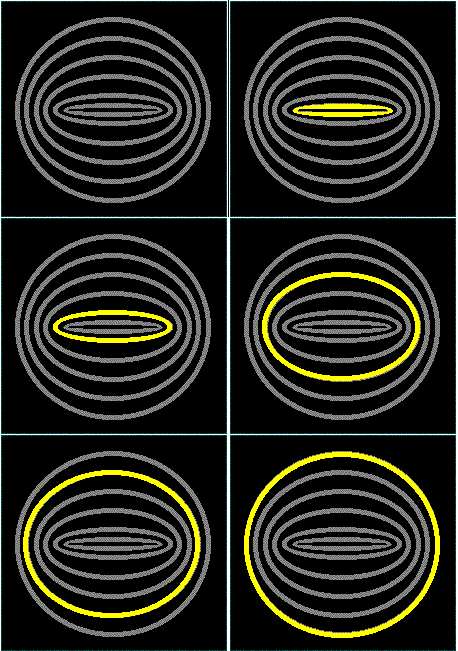 Same focal points. |
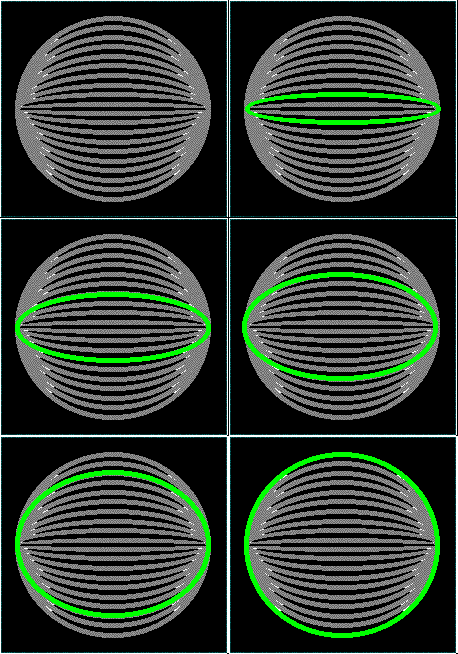 Same vertices. |
Total distance between any point on an ellipse curve and the two focal points is a constant: same sum for both lengths regardless of chosen boundary point.
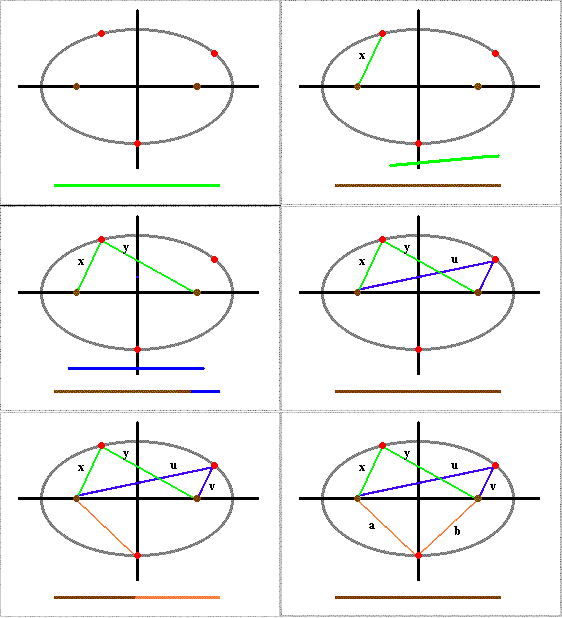
x + y = u + v = a + b = constant
For a circle the two focal points coincide - they are both at the center. The circle center-to-curve distance is the radius. It is the same for all boundary points.
| 11/21/10 Version | http://www.cs.ucla.edu/~klinger/nmath/ellipse.html | |||
| ©2010 Allen Klinger |