SOLIDS
Algorithms and Approximations


Recall is a technical term in search. It refers to the (possibly very many) terms returned. A counterpart is relevance. That term points to the practical reality: many recalled items are not useful.

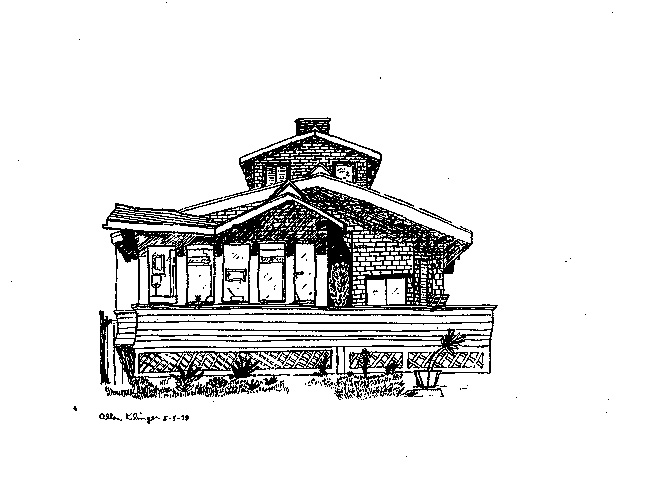
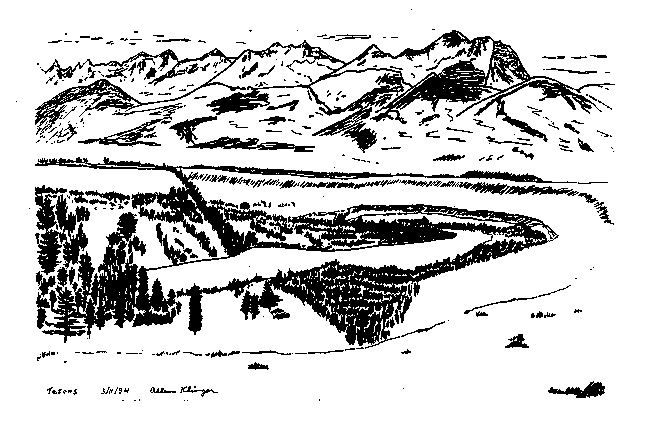
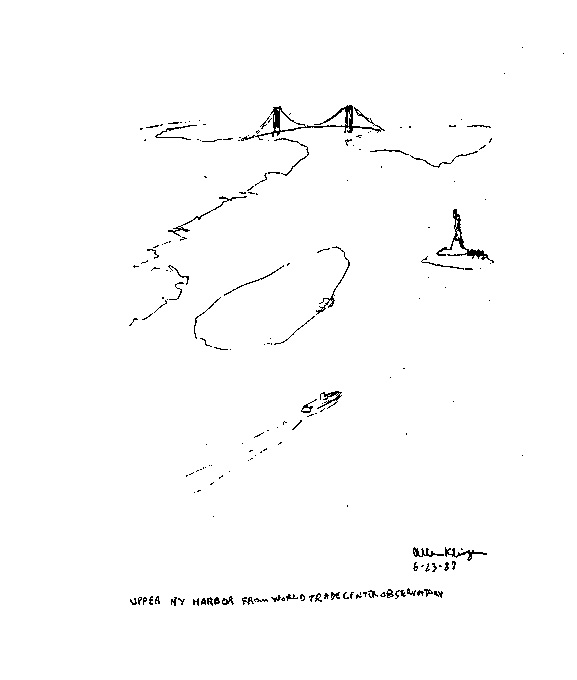
Abstraction and description are similarly paired terms. The first can be thought of by referring to the following three line drawings. Each presents some detail and in so doing conveys the notions of a beach house, the Snake River, and Upper New York Bay.

Words - e.g., the names of distinct mathematical curves - present another way to abstract some details and in so doing convey the essence of a situation.

We could argue that visual and literal abstraction are just ways to deal with some aspects of reality, and that quantity is another. These things come together in some cases involving irrational numbers (and some geometric issues about them).

Here is a brief statement of something that could be viewed as an interesting open problem in mathematics and computing:

(We) would like to see ... an algorithm that creates such good approximations as

2^[(5/2)^(2/5)] = 2.718290995


However the idea of a regular procedure leading to an approximation is somewhat akin to having a blank page and moving from it to some drawing like the detailed ones shown here.

The following visuals illustrate the pragmatic virtues of words and mathematical concepts as ways to deal with physical properties. (Click on any of the three images to see a larger version.)
Marina del Rey, California Recalling the Snake River, Wyoming
New York, New York from World Trade center towers destroyed 9/11 Named mathematical curves School of Mathematics and Statistics, St Andrews, Scotland

Some Interesting Irrationals

√2, Square Root of 2 e, Natural Logarithms' Base Numerically
π, Circle Circumference/Diameter Ratio φ, Golden Ratio Π, Hard to compute irrational number

Approximations

2[(5/2)(2/5)]

= 2.718290995**

(2143/22)(1/4)

= 3.1415926***

Algorithms
Numerical Square Roots Visual Square Roots

*Small print in drawing reads: "Upper New York Harbor from World Trade Center Observatory, 6/23/87".
**Brewster, G.W. The Mathematical Gazette, 25-263, 49, Feb. 1941;
cited in Gaither, C. C. and Cavazos-Gaither, A. E.,
Mathematically Speaking, A Dictionary of Quotations, 1998 ; the exponent for 2 is 5/2 raised to the 2/5.
***Ramanujan; cited by Gardner, M.
The golden ratio φ = (1+ √5)/2 = 1.61803...

The golden ratio conjugate Φ = 1/φ ≈ 0.6180339887

Φ/2 = (√5 - 1)/4 = sin 18 ° = sin π/10 ≈ 0.309

(2sin π/10)(1+ √5)/2 ≈ 1

http://www.geocities.com/titus_piezas/Ramanujan_a.htm

http://www.c3.lanl.gov/mega-math/workbk/infinity/inhotel.html (by Nancy Casey, 1991) words->images??

http://www.nytimes.com/2008/05/20/health/research/20brai.html
For further Exploration or Examination consider adapting exposition to computer capabilities.
5/21/08 Version http://www.cs.ucla.edu/~klinger/mathy.html
©2008 Allen Klinger